Oak Warriors is a set of naval wargaming rules by Nigel Emsen, edited by Stephen Stead.
Rules are available at: https://www.wargamevault.com/en/product/347480/oak-warriors-rules-qrs-and-tokens-for-the-age-of-sail
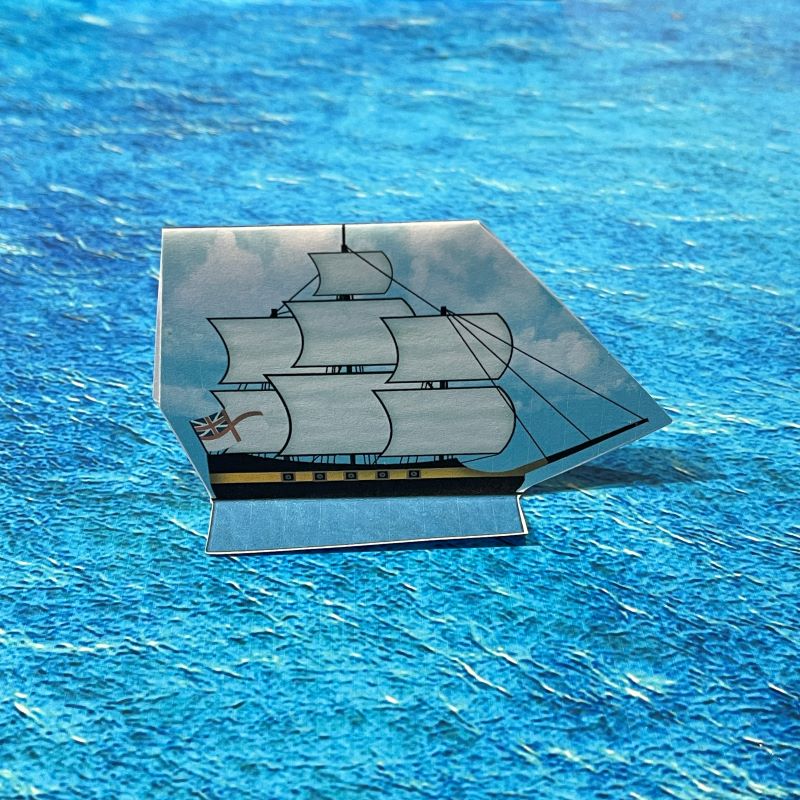
You can use whatever ship models you own. Measurements are in inches.
The game uses D6s. A D12 sets the starting wind direction, though the rules let you roll 2D6 instead if you haven't got one.
Getting your ships to follow orders
The signal system is what interests me most. Each ship has orders represented by tokens placed face-down behind it. Ordinary ships have two signal slots, Squadron Commanders have three, and the Fleet Commander has four.
You choose an order, then roll to see whether the crew understands it. Better crews are more reliable. Fail and the ship normally repeats its last successful order. You wanted a turn? It might carry straight on.
After attempting a signal, you replace its token with another face-down order. The last successful signal stays face-up behind the ship, so you can see what a failed roll would mean before choosing your next move.
A Squadron Commander's Follow Me signal lets nearby ships follow the same order on one successful crew roll. They must be visible and within 12 inches. If the commander fails, they resolve their individual signals.
Navy or pirates?
Navy ships operate in fixed squadrons of two to six vessels. Players alternate activating a squadron or, for pirates, an individual ship.
Pirates have no squadrons or Squadron Commanders. Their Fleet Commander can still pass signals directly to nearby ships and use Follow Me.
Pirates also get boarding bonuses and can sail under a false flag. Until the deception is detected, the enemy cannot target them. Firing or attempting to board gives them away.
Sailing and fighting
Movement depends on ship type. First Rates have a base move of 6 inches, Second and Third Rates get 8, and frigates and brigs get 10. Turning costs movement, as does ending a move into the wind.
Either player can shoot during the movement and shooting phase, including during an opponent's move. Each broadside can fire once per turn. Short range is 6 inches; ships of the line can also fire out to 12 inches.
Hits remove hull points. Some also cause a Damaged effect, reducing movement and halving shooting dice, rounded up. Raking fire causes extra damage.
There are no separate crew or rigging records. A ship reduced to zero hull points becomes Critical and stays on the table as a drifting wreck. It cannot be repaired or captured. Repairs can remove a Damaged effect from other ships, but never restore hull points.
Boarding requires a Board/Capture signal and contact with the target. Each side rolls a D6 for every remaining hull point. Most successes wins and captures the other ship. Both ships lose a hull point from the fighting. Pirates get an extra die and add one to each roll.
What else is included?
Victory usually depends on the scenario, which might involve escorting transports or breaking a blockade. Optional rules cover armour and early steamships. Steam-powered First and Second Rates improve their sail grade by one and ignore the into-wind penalty.
The PDF includes quick reference sheets and printable signal tokens. Nigel also has a fantastic range of printable paper ship models available on Wargame Vault https://www.wargamevault.com/en/publisher/12033/nigel-emsen